Pursue the Right Work
Understand how Federal demand becomes opportunity, choose where the firm can compete with purpose, and build the market presence and pipeline discipline needed to focus limited attention.

Winning and Delivering
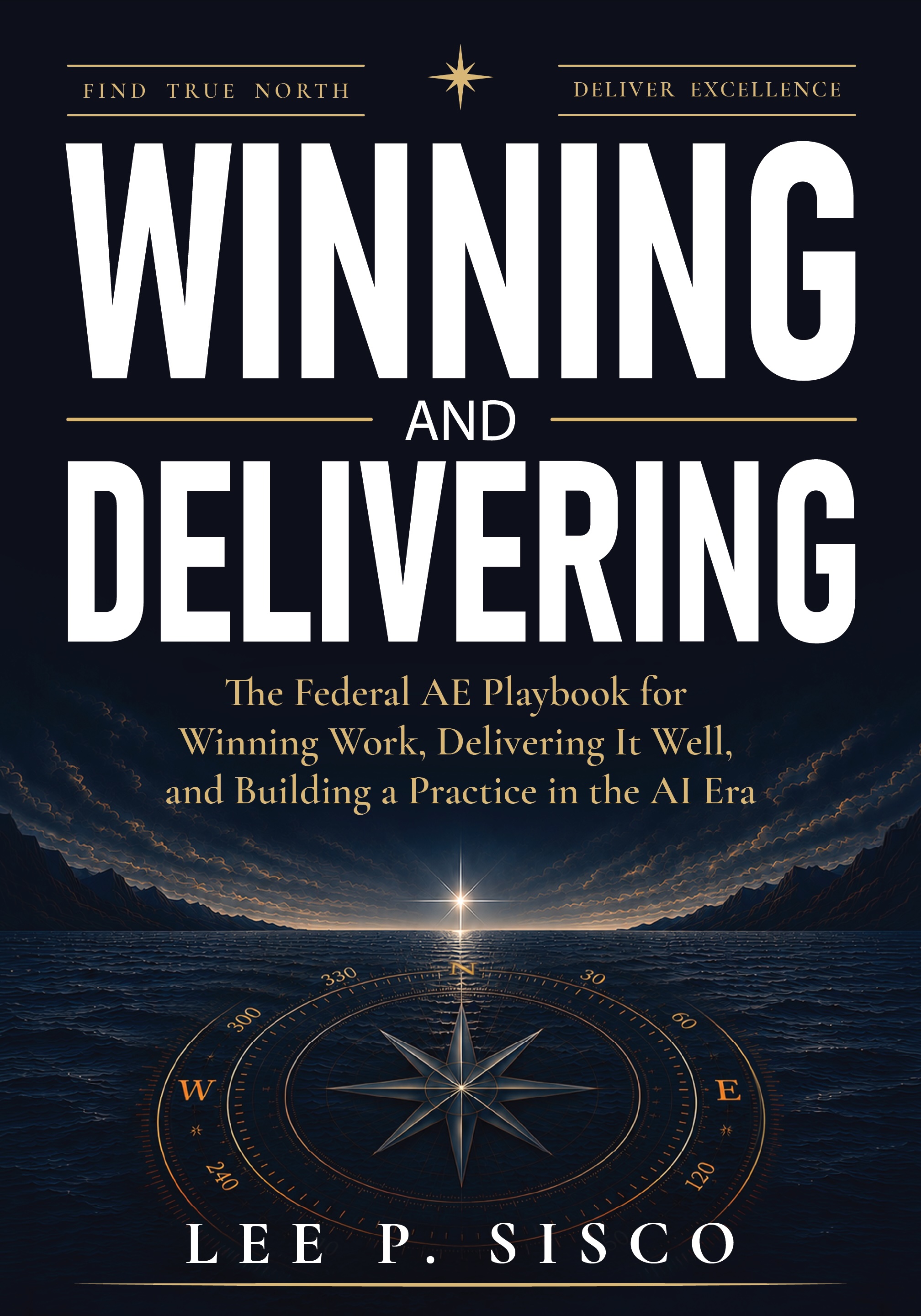
By Lee P. Sisco
Winning and Delivering is a complete, plain-language playbook for practitioners across the full lifecycle of Federal AE work. It connects the market, the client, the pursuit, delivery, and the work of building a practice capable of sustaining all of them.
I wrote it for the practice leader deciding where the firm should go, the business developer and capture professional working to win the right opportunities, the project manager responsible for delivery, and the emerging professional learning how Federal AE work fits together.
Author Perspective Connection
When I entered Federal AE after a career in the United States Navy, I found a complex profession whose most useful knowledge was often passed from one practitioner to another through proximity and experience. Much of what people needed to know was available, but it was rarely assembled in one place or connected across the full practice.
This is the book I wish I could have handed to myself when I entered the field.
I spent nearly a decade leading a regional Federal practice and learning how market strategy, capture, delivery, people, and operations reinforce one another. I wrote Winning and Delivering to make those connections visible and to preserve lessons that otherwise remain in the heads of the people who learned them the hard way.
I served 24 years in the United States Navy, culminating in command of the nuclear attack submarine USS Louisville. I then spent nearly a decade in Federal architecture and engineering, leading the East Region Federal practice of one of the nation's largest AE firms.
Those careers placed me in different environments, but the leadership demands were familiar: understand the mission, assign responsibility clearly, prepare people to perform, exercise judgment when the process cannot supply the answer, and learn fast enough to improve the next time.
Winning and Delivering brings that practical leadership perspective to Federal AE work.
Book Themes
Understand how Federal demand becomes opportunity, choose where the firm can compete with purpose, and build the market presence and pipeline discipline needed to focus limited attention.
Connect positioning, capture, pursuit decisions, proposals, interviews, and fee decisions to the client's needs and the capability the team will bring to the work.
Treat delivery as the foundation of the client relationship and the performance record that follows the firm into future opportunities.
Connect culture, structure, quality, performance management, talent development, institutional learning, and human judgment into a practice capable of repeating what works, including as AI changes the tools.
The book follows Federal AE work from understanding the market and choosing opportunities through capture, delivery, and practice leadership. It shows how decisions made in one part of the practice shape what becomes possible in the others.
Its practical foundation is human as well as procedural. People need ownership, preparation, resources, and room for judgment. Organizations need to examine experience, preserve what they learn, and make that knowledge useful in the work that follows.
Relationship to Polaris
Winning and Delivering sets out the broad ideas and experience that inform my work through Polaris Strategy & Capture Consulting. It is written for practitioners across the field.
In consulting, I use the same connected perspective to help a leadership team examine the specific question in front of its practice.
Closing Section
Winning and Delivering is meant to help practitioners see the whole practice, understand how its parts connect, and carry useful knowledge forward.